
HOP Training
Our HOP Fundamentals and HOP & Learning Teams courses were the first in Australia and New Zealand. We have now grown to attract a global audience of safety professionals interested in learning the foundations of HOP.
Find a Course
What is HOP?
It focuses on understanding the context and conditions of work, recognising the complex interactions between people and systems. HOP helps us to understand how humans perform and gives us a framework for building more resilient organisations.


Burgeoning bureaucracy and increasing compliance demands have led many organisations to search for different ways of doing safety. Some organisations have even felt their safety efforts have made organisational performance worse while delivering no safety benefit.
HOP has developed as an operational philosophy based on the works of thought leaders such as Todd Conklin, Sidney Dekker, James Reason and many more. It takes the perspective that safety is just one of many emergent outcomes from work and focuses on making work better and building capacity to ensure success.
By taking this approach we can improve across a range of outcomes including quality, safety and productivity.
The HOP approach identifies and amplifies the excellence that already exists within an organisation. Focusing on a deep understanding of the work from those who know it best, it optimises system conditions and, where possible, reduces constraints. Ultimately, the focus is on creating the conditions for success – not just to avoid failure. HOP in its very nature does not take a binary view of what is valuable and what is not in safety practice.
Rather, HOP:
Critically, HOP is an integrative process.
It requires a holistic approach that involves leadership, management systems, people and practices. HOP is about our conversations, about the way we treat each other, about listening and learning from those who do the work, and appreciating their depth of knowledge in the way operations run.

Watch HOPLAB Founder Andy Shone, introduce HOP as an operating philosophy.
Human and Organisational Performance is based on five principles that shape and influence the way organisations think, act, view success and respond to failure. These five principles are integrative and work together to change the way we think about work and how to improve it.
Discover the five principles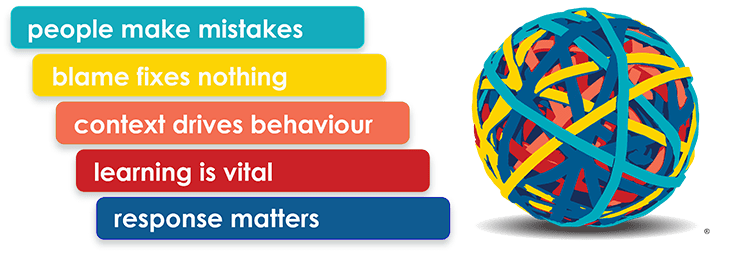
A tailored approach
Our HOP Fundamentals and HOP & Learning Teams courses were the first in Australia and New Zealand. We have now grown to attract a global audience of safety professionals interested in learning the foundations of HOP.
Find a Course
We guide organisations to develop and facilitate operational learning through a suite of tools and methods to understand how work is really done, including Learning Teams, Field Insights and Event Learning.
Explore Operational Learning
HOP integration is an ongoing approach to understanding the complexity of both failure and success. This is in addition to the key focus of learning from normal work. We help organisations adopt HOP and operational learning through integration.
Discover HOP Integration
We often get asked how the terms Safety II (Safety 2) and Safety Differently relate or compare to Human & Organisational Performance? There are a number of terms being used to describe different facets of what has been collectively referred to as the 'new view' of safety. While they have different origins, many of these terms have arrived in a very similar destination. The approaches and methods that are accepted, promoted or utilised by HOP practitioners would be equally useful for an organisation adopting a Safety II or Safety Differently approach.
Trusted by leading companies across Australia, New Zealand and the world.






















Ready to get started?

Get the latest information and insights on Human and Organisational Performance delivered to your inbox.
Sign up here
Build your understanding of Human and Organisational Performance with our flexible, self-paced online course.
Check it out
Talk to us about how you can start your HOP journey and transform how your organisation thinks about safety.
Give us a call